Friday, 21 December 2012

A Christmas message from Olive at International Animal Rescue in Goa


The Improbable Love Birds 
Hello dear friends!
Today I bring you a heart-warming tale for the festive season.
The shy pigeon
Recently at Animal Tracks we observed the development of an unlikely but enchanting friendship between a fledgling crow and a young pigeon. Unfortunate circumstances had led to both wild birds being separately admitted to the centre: the immature crow was still unable to fly and the pigeon weak and exhausted, both had been rescued and handed to IAR as they would not have survived in their natural habitat.
The two birds were placed in recovery cages side by side within a larger enclosure used at the rescue centre to house cats, kittens and pups and other creatures at various stages of recovery and convalescence. Both settled well and soon began to flourish in the protected shelter. The pigeon quietly feasted on a diet of seeds and grain whilst the crow greedily devoured anything and everything offered to him. Possibly realising that, now they were safe and were fed regularly, no harm would come to them, they both relaxed and became comfortable in their temporary confinement.  They began to unmistakeably converse with each other, nattering away together from their adjacent separate cages, cheerful raucous calls from the crow and soft warbled cooing from the pigeon communicating in their own private language.   
The handsome crow

As time passed and the feathered friends improved and grew stronger, the doors of the cages were left open so that they could freely move around the high spacious animal house during the day and to encourage them to stretch their wings and attempt flight.

The pigeon was the more advanced and soon fluttered to the high rafters of the enclosure where it surveyed the crow cheekily hopping around and inspecting the other temporary inmates while constantly keeping a watchful eye on its friend. When one bird moved to another area of the enclosure the other would instantly follow, both gaining confidence and strength and a sense of well-being from their unlikely allegiance. The crow would tilt its head back with open beak and gesture the pigeon to feed it just as it would have done with its mother in the wild. Encouraged by his friend’s flying the crow soon began to flap his wings and take his first tentative flight into the air, joining the pigeon on the rafters where they curiously observed all the rescue centre goings-on beneath and around them. Then a few days ago the veterinary team decided they were ready to be released and the external door to the outside world was left open for the duo to venture out in their own time. Before long off they flew into the surrounding wooded countryside together.
Love birds
We shall never know if the two friends will continue to remember each other or remain in contact, but both of their young lives have surely been enhanced by the special bond forged during their stay at Animal Tracks. The shy and peaceful pigeon is maybe still around yet unobserved but the crow is spotted regularly and visits the centre each day to check on his old friends and hopefully grab a free meal.
If asked to name an appealing or endearing creature, crows and pigeons would probably not be the choice for many, both birds are considered by many to be universal troublesome pests to society.  But having recently witnessed the joyous unreserved acceptance of each other’s existence demonstrated by these two very different birds, free from any acquired malice or prejudice, maybe we could learn a lesson from them in dignified behaviour and coexistence.    

Firm friends
These two innocent young birds, free from the predisposed suspicion and discrimination customarily learnt from family and flock, have shown that nurture is indeed as important as nature, they intuitively disregarded the differences between them and simply accepted and absorbed the best from each other. At Christmas, the festive season of goodwill when thoughts of compassion, peace and joy are particularly evoked, it is not necessary to be a Christian or even religious to hope that we may all extend that benevolent attitude to all the creatures of the world and learn from, protect and cherish all the birds and animals around us.


So that’s all from me for 2012. Have a very merry, cruelty-free Christmas and I look forward to bringing you more news from Goa in 2013!

Love from Olive x

Wednesday, 5 December 2012

Olive's Diary comes to us from International Animal Rescue in Goa


From porcupine quills to pickle jars
Hello, hello!
The variety of work here at the IAR Animal Tracks centre in Goa is vast and the team never know what they are going to encounter next. Along with the hundreds of relatively routine vaccinations and sterilisations each month there are regular calls to assist animals in unusual and potentially life threatening situations.
Countless hazards can beset Goa’s animals, particularly feral dogs that live by their wits and learn from experience if they are to survive in an often harsh environment. Amongst the numerous dogs that arrive daily at Animal Tracks, this week there were two emergency admissions that had both come to grief but through very different mishaps.
The dog prior to release
One poor dog had got his head well and truly stuck in a pickle jar but, thanks to a caring young boy who spotted him and made a telephone call to IAR, help was dispatched immediately. When Sarvesh arrived on the scene the dog was so frightened by his own unsuccessful and prolonged attempts to remove the jar he ran away and managed to avoid capture.  The consequences would have been horrendous for him with the jar tightly jammed around his neck, unable to drink, eat, see or even breathe properly. Another IAR team consisting of Manoj Gokul and Abhinand made a return mission to the area and this time soon found the dog sitting exhausted in the shade of a banana tree, head still firmly trapped in the jar. This time he was more than willing to be gently apprehended and taken back to the rescue centre where he was swiftly released from his suffocating plastic prison.
What a relief for the poor animal!
So please, wherever you are in the world, take heed of this incident and dispose of your waste empty containers safely and mindfully. Any thrown out empty vessel can be a potential trap for some creature. Food fragments will attract birds and animals that can easily become trapped in plastic or wedged tight in cans and containers only to die a slow, wretched death.
Marine animals and sea birds as well as land creatures are often found dead or with horrific injuries after becoming ensnared in the discarded polythene that holds together packs of canned drinks. The inconsiderate disposal of so many of our everyday items is potentially lethal for any domestic or wild creature.
But fortunately for this dog he was successfully rescued and freed from his torment. He’ll have a few recuperative days in the Animal Tracks shelter to get over his trauma, then he’ll be sterilised and vaccinated and returned home before too long.

Happy, but no doubt a bit shaken by his ordeal

The second incident involved another dog that had been horrifically impaled in the throat by a porcupine quill.
Porcupines are relatively slow moving creatures that dispense with predators by backing into them using the quills as weapons which are painfully embedded into their pursuers. The expelled quills then regrow to maintain the porcupine’s highly effective armour.
The quill was firmly stuck in the poor dog's throat
Having survived the injury, but still with the sharp quill implanted deep into his neck and painful infection setting in to the wound, the poor creature had sought sanctuary on the balcony of a local school. The concerned children alerted the office staff who called for IAR assistance and Krishna and Sanda were sent to the scene. The highly efficient defence mechanism of the porcupine would so surely have proved fatal for this poor dog had it not been for the prompt and expert veterinary treatment he received on his admission to Animal Tracks from Dr Manik and vet nurse Maruti. Together they carefully removed the 9 inch quill that was embedded 4 inches into the throat of the dog!
This dog will of course need to stay at the centre for a time while his deep infected wound heals with the administration of regular medication in the clean kennel environment, but then he too will be sterilised, vaccinated and taken home.
This dog is lucky to be alive
We’d like to hope that both dogs have learnt from these near death experiences and will consider carefully the consequences of messing with a porcupine or jamming your head in a pickle jar!
But if not help will always be at hand from everyone at Animal Tracks and the caring people who alert the centre to animals in need.
That’s all from me for now!
Love Olive x

Monday, 12 November 2012

What A Difference A Month Makes


Hello my friends
World Animal Day on 4th October every year is a global celebration for human beings to acknowledge their fellow creatures.  It was established in 1931 by ecologists in Italy to heighten the awareness of endangered species. Since then animal lovers around the world identify 4th October as a day to display their compassion and united support for the plight of all animals, whether they be companions, support, or simply wild creatures in need of our protection.
World Animal Day is an affirmation of our appreciation of how all animals enhance the lives of us humans.
Ironically a young male German Shepherd was found by the Animal Tracks team after he had been abandoned close to the rescue centre on 4th October. He was hardly recognisable as a German Shepherd, he was in such appalling condition. He had a chronic skin infection, sparse patchy fur and was malnourished to the point of starvation. Of course as always IAR sprang to his aid and took him into the kennels where he received intensive care and kindness and the nutritional food he had so obviously been without.
Poor Bruno was in a sorry state when he was taken in by IAR Goa
We can never know the torment and neglect that the poor creature suffered before he was rescued but what we do know is that he has found his human. A lovely local man called Gopi agreed to adopt him and named him Bruno. Needless to say IAR Goa will provide the obligatory back up and support and the first year’s free veterinary care should Bruno need it.
Bruno is now recovering well with treatment from
IAR Goa and a new loving home with Gopi
Tragically there seems to be an ever increasing amount of pedigree dogs that come to be abandoned and in similar condition: these dogs are bred purely to be sold as a commodity and satisfy the greed of man. Why breed dogs and cats when there are countless wonderful animals already born? Pedigrees are not nearly as hardy, economical or easy to feed and maintain as the indigenous Goan dogs who thrive on affection and would be your friend for life given half a chance.

Of course Bruno has been saved and his future welfare will be observed but there are countless others out there who are not so fortunate.

Animal Tracks has a constant flow of cats and dogs for re homing, all seeking the salvation of a good caring local home. The photographs of Bruno were taken just five weeks apart and are undeniable evidence of how rapidly healing can occur when we open our hearts to embrace a rescue animal like Bruno.
That’s all from me for now!
Love Olive x

Wednesday, 31 October 2012

Alfie gets a glowing progress report


Hello hello

After suffering a horrible setback when he was only three months old, young dog Alfie and his brother Race are reported to be healthy happy hounds enjoying the best that life in Goa can offer, including the love and care of the local community. Some people can’t tell the twins apart, but we dogs have no such trouble with our canine friends – it’s not about the look, it’s all about the smell!  Alfie now lives with his former foster carers Jan and Nigel, but spends hours on the beach with his brother and the rest of the pack.

Not everyone has heard the story of Alfie’s earlier misfortunes, so let me fill you in. And even if you are reading it for a second time, you may need to have some tissues at the ready ...

Like two peas in a pod!
Alfie and his twin brother Race enjoyed a seemingly safe and almost idyllic existence within the small semi-feral pack of dogs that live in the vicinity of a cluster of quiet guest houses nestled between palm groves behind the dunes of a large expanse of unspoilt beach. All the dogs were happy and healthy. Alfie's mum Lemon had recently been sterilised and vaccinated and the entire pack's welfare was being monitored by IAR Goa. When the time came the twins were also scheduled to be vaccinated and sterilised.

But one day when they were only about three months old a proprietor of one of the guest houses, who had recently happily adopted an IAR rescue cat, called to alert IAR that one of the pups had been involved in an incident and had a severe facial injury. IAR volunteers immediately went to investigate and found the poor terrified pup in a horrible state. They took him to Animal Tracks where he was seen immediately and given shock reducing and painkilling injections, he was then examined and X-rayed which revealed his jaw had been broken in three places, through both sections of his chin and again at one hinge joint.
Poor Alfie's broken face

No external wounds were visible but his teeth were smashed. The conclusion was that the damage to Alfie's bones must have occurred through a heavy impact aimed directly to his jaw. The awful fact dawned on his rescuers that this was not an injury sustained by attack from another dog or even a road traffic accident, but that Alfie had actually been hit in the face by a person most probably wielding a heavy stick or some other implement.

But at such a young age the vets knew it was still possible for the growing pup's soft bones to heal, despite the extent of the damage, but to immobilise his jaw in order for this to take place would involve prolonged and intensive aftercare. With a massive amount of animals in need of care constantly arriving at Animal Tracks each and every day this degree of round the clock nursing would be very difficult and time-consuming for the busy staff to undertake, so two long-term volunteers very kindly agreed to take on the case and care for Alfie at their home.
Skilful work by our fantastic team

Alfie was anaesthetised whilst his face was put back into position, stitched through the jaw bones and firmly bandaged and taped up. In order to medicate and feed him without the use of his mouth, an incision was made and an oesophagus tube inserted through Alfie's neck and the arduous healing process began.

The most difficult part of the task would be to ensure he received enough liquidised food to sustain him through a long period of crucial growth and healing. Alfie was fed and medicated by slowly and frequently syringing the processed mixture into the tube, ensuring he received small sustaining amounts at regular intervals. For the first few days he was heavily sedated with pain relieving drugs and antibiotics and put up little resistance to his new situation and was a willing and cooperative patient.

Despite having been attacked in such a cruel and brutal way, Alfie strangely did not appear to fear his human carers, it was as if somehow he understood why this was all happening and that it was necessary in order for them to help him live.

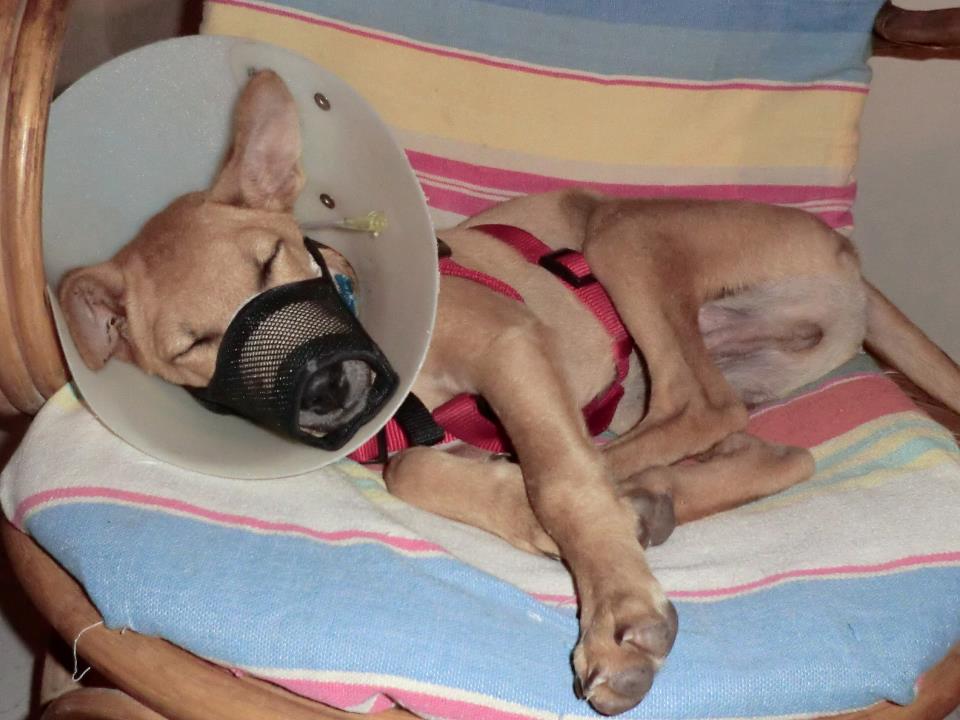
Voiceless, Alfie’s only means of communication was through the expression in his sad eyes, the rest of his face was swathed in bandages and surrounded by a plastic Elizabethan collar all stitched to a body harness to ensure his jaw was kept clean, protected and immobile. Gradually the bones began to mend and Alfie's regular check-ups at the Animal Tracks outpatients department showed he was healing well and gaining weight despite his very restricted and unusual feeding programme that bypassed his mouth and went straight to the stomach.
Heavily sedated after his operation

Poor Alfie could not understand why he could not chew and taste and poke his nose into everything and all the other things an active young pup would normally do. But he became quite a celebrity amongst the local community, receiving many well-wishing visitors at his foster home who were all eager for the pup to recover and interested in the healing process.

Finally, after 28 long days and nights, the long-awaited appointment came for the bandages and tube to be removed and for the first time Alfie's sweet face was fully visible. Most of Alfie's human friends had only ever seen him shrouded in bandages and the ever present restrictive but essential protective Elizabethan collar. Despite losing a few teeth, Alfie's profile was amazingly perfect, entirely thanks to the care of the entire Animal Tracks veterinary team, particularly expert renowned orthopaedic surgeon Nikhil.
Alfie after his bandages and cone were removed

And so the young pup that had spent a great portion of his short life restricted from using his nose and mouth was able to enjoy solid food, drinking and freedom for the first time in weeks. Soon he began to gain weight and play and interact with the other neighbourhood dogs and animals at his foster home almost as if the awful trauma had never happened.

But sadly the weeks away from Lemon and Race had been too long for him to be reintegrated back to the semi-wild pack, Alfie's dependency on human care had become such that he has been taken as a permanent member of the foster household where he healed. But as it's close to his old canine family he still gets to visit and run with his old pack on the beach and now bears few mental or physical scares from his ordeal, apart from having an understandable terror of anyone holding a stick.

Alfie and Race enjoying some beach time with a friend!
Seeing Alfie and Race tumbling in the surf, play biting and fighting and simply revelling in each other's company is a joy to behold, especially as neither Alfie nor countless other dogs would be alive at all if not for the intervention and care of the wonderful IAR Goa team and volunteers.

That’s enough from me for now!

Love Olive x


Wednesday, 24 October 2012

Double Trouble for Chutki


Hello my friends

Today I bring you a sweet story which illustrates just how much we dogs in Goa depend on humans like you to look out for us and step in when things go wrong.

There are literally thousands of stray dogs living in Goa: indeed I was one of them until IAR saved my life and gave me a home.Thankfully, just like me, a massive proportion has been treated by IAR at various stages of their lives and many have been sterilised, vaccinated and returned to their area. These feral dogs do not necessarily desire or need to be treated as pets and can lead a contented, social existence amongst their small or extended packs and usually keep within the laws of canine territorial boundaries that govern how things work in the world of dogs. This is an alien concept to most of the western world where the idea of stray animals is synonymous with human abandonment or neglect. Of course if humans offer a helping hand by giving food or providing some shelter from the elements, this is an extremely welcome bonus. But if the animals are not sick or breeding out of control and fighting for territory, life as a free dog really can be a good one. And to coexist within your pack amongst a tolerant human community is not such a bad place for a dog to be.

Some prefer to avoid the close company of people whilst others enjoy the relationship and choose to live alongside their human friends. These social dogs are widely accepted as an enhancement in many communities and are happily tolerated without actual encouragement. The dogs offer protection from intruders and alert communities to snakes and other potential dangers in exchange for a little food and shelter.

A street dog named Chutki is one such animal. She has no owner or specific human companion but is viewed as a friend by many local vendors and semi-permanent seasonal workers who make a living selling food, trinkets and artefacts to the tourists drawn to the scenic clifftop location where she roams.  And these locals look out for Chutki and feed her. So when she developed a large swelling on her side, the locals were quick to alert the IAR volunteers living close by who they know to be associated with Animal Tracks and would offer help to any creature in need.

Chutki was contained within one of the small shops, making it relatively easy for the rescue team to catch and admit her for treatment at Animal Tracks. Chutki was examined by a duty vet and diagnosed with a fast growing and potentially dangerous haematoma. Often these blood- filled swellings will burst and become infected with potentially lethal consequences. Lucky for Chutki, she was given the necessary drugs and the swelling responded quickly and favourably and began to recede without the need for surgical intervention. Within a couple of weeks she had recovered enough to be returned to her patch and was welcomed home by all.

Poor Chutki with her injury
But then only a matter of days later she was in trouble once more. The same IAR helpers were asked to take a look at Chutki after her friends reported that she had sustained a gory injury whilst chasing a cat. During the pursuit through the undergrowth she had managed to get herself virtually impaled on a jagged tree stump. The impact had torn a deep hole in her side which would certainly have led to a painful and lingering death if not for her human friends who alerted IAR once again. An animal ambulance was called in order to transport the injured and bleeding Chutki gently  to Animal Tracks. For her own safely she was contained within a travel cage as is the norm for a wounded animal.

On arrival at the centre she was examined by the duty vet and injected with medication to help ease the pain and shock. The deep cut was fresh but contaminated by splinters and debris. Immediate surgery was necessary to clean and close the wound, as without prompt action infection would have set in and threatened Chutki's life. In the tropical Goan environment untreated wounds can fester and become poisoned in a few hours.

Luckily she recovered well
After the emergency surgery the long healing process began, but this time Chutki knew that she would be returned home eventually as she could recall positive memories of her previous recent stay at Animal Tracks. Chutki knew she was in good hands and was a cooperative patient resigned to another enforced captivity whilst she recovered.

And before too long she was returned home to yet another warm welcome by canine and human friends alike. The warm relationship that has developed between this street dog and the humans with whom she coexists has saved her life twice within a very short space of time. Let's hope that  after these recent incidents Chutki manages to stay out of harm's way from now on, but if not there will always be caring watchful eyes looking out for this fortunate dog who is owned by no one but befriended by all.
Look at that beautiful face!

That’s all for now!

Love Olive x

Monday, 24 September 2012

Axle the Accidental Adventurer

Hello my friends!

When Mr Shabudin Emeti started up the engine of his truck early one recent Sunday morning for the round trip from his home in the market town of Mapusa to Panjim city, he was oblivious to the secret stowaway he was taking along for the journey!

He parked the vehicle in the city and was away on some business matter for only a few minutes. On his return some bystanders who’d witnessed him arrive alerted Shabudin that they could see a dog beneath the truck cowering and balanced on the fuel tank between the body underside and the driveshaft (or rear axle), and that the dog had been there when he arrived.

The dog cowering on the fuel tank
Obviously the dog must have been there since his departure from Mapusa, he had probably climbed to a dry space to sit out the previous night’s monsoon rain.

Shabudin was concerned as to the condition of the dog: after the ordeal of the unexpected treacherous excursion, had it sustained some horrific injury? Was it likely to be in an aggressive state? Could it be sick and dangerous? The only solution for the safety of all would be to seek help and luckily for “Axle” Shabudin knew of International Animal Rescue and Animal Tracks and decided to take his vehicle and its uninvited passenger to the rescue centre and seek their help.

Using particular caution to avoid any potholes that might jolt the suspension that was so close to Axle and could have crushed him, he drove at slow speed, hoping not to inflict any further harm on the poor dog in his self-imposed precarious perch where he’d been positioned for at least 35km.

On arrival staff at the centre at once prepared to remove and help the dog, anticipating that he would most probably be badly injured. Gently Gokul, IAR’s kennel manager, tried to coax the terrified animal out of his hiding place huddled amongst the mechanical components beneath the vehicle.

Axle being extricated with a catchpole
But Axle was not about to come out easily, he was so terrified and traumatised from the ordeal and had no idea that these people were trying to help him. So Gokul had no option but to slip a catch pole loop gently around Axle’s neck and slowly extricate him from his hidey-hole beneath the truck. Still fearful and in obvious shock, Axle was taken to a kennel and examined for injury.

Amazingly there was not a scratch on him: he was covered in oil and grime and wet from the monsoon puddles lying on the roads, but otherwise completely unscathed.

An amazed Shabudin returned home after giving IAR staff exact location details for Axle’s return. Axle is not sterilised, so after he recovers from his exploit in the safety of the Animal Tracks kennels for a few days, he’ll have the surgery, be vaccinated  and then taken back to his home territory.

Axle safe at Animal Tracks
Next time he’s looking for somewhere to shelter from the rain for the night, he’ll no doubt choose a permanent spot that doesn’t move on in the morning!

That's all for now!
Love Olive x

Wednesday, 5 September 2012

Orphaned squirrels come on in squeaks and bounds!

Hello again!

Here’s a sweet story about some special squirrels: three tiny orphaned Three-Striped Palm Squirrel pups arrived recently at the Animal Tracks centre and, being too young to survive without their mother, their care was immediately undertaken by IAR's Abby who has a wealth of experience in successfully rearing a variety of rescued wild baby creatures.

The pups are thriving
The three little pups soon settled into their temporary home and eagerly thrived on Abby's regular feeding regime of chickoo, papaya, banana, custard apple and cerelec (a dietary supplement often given to orphans of many species that are cared for at the centre). Time has passed and the pups have grown stronger and more inquisitive: one in particular seems to stand out as leader of the gang, being more active, naughty and adventurous than the other two. Now, as they've reached about seven weeks old, it has become necessary to build them a larger cage in which they can exercise and play. Their new enclosure will eventually be hung outside in a tree: it has a little flapping door which will be released allowing the pups to come and go as they please, easing their transition back into the wild when they feel ready.

Three's a crowd at mealtimes!
In the wild they would be weaned at about ten weeks old. But for now their new purpose-built house will provide them with a safe, dry shelter where they can return for food and sleep until the day eventually comes when the three little squirrels become confident enough to take their final leap into the big wide world away from Animal Tracks, bidding farewell to all at the centre, with particular thanks to nanny Abby! According to ancient legend, Three-Striped Palm Squirrels are closely associated with the Hindu deity Lord Rama, giving these little rodents a sacred and protected status throughout India. So they really are very special indeed. That’s all for now!

Love Olive x